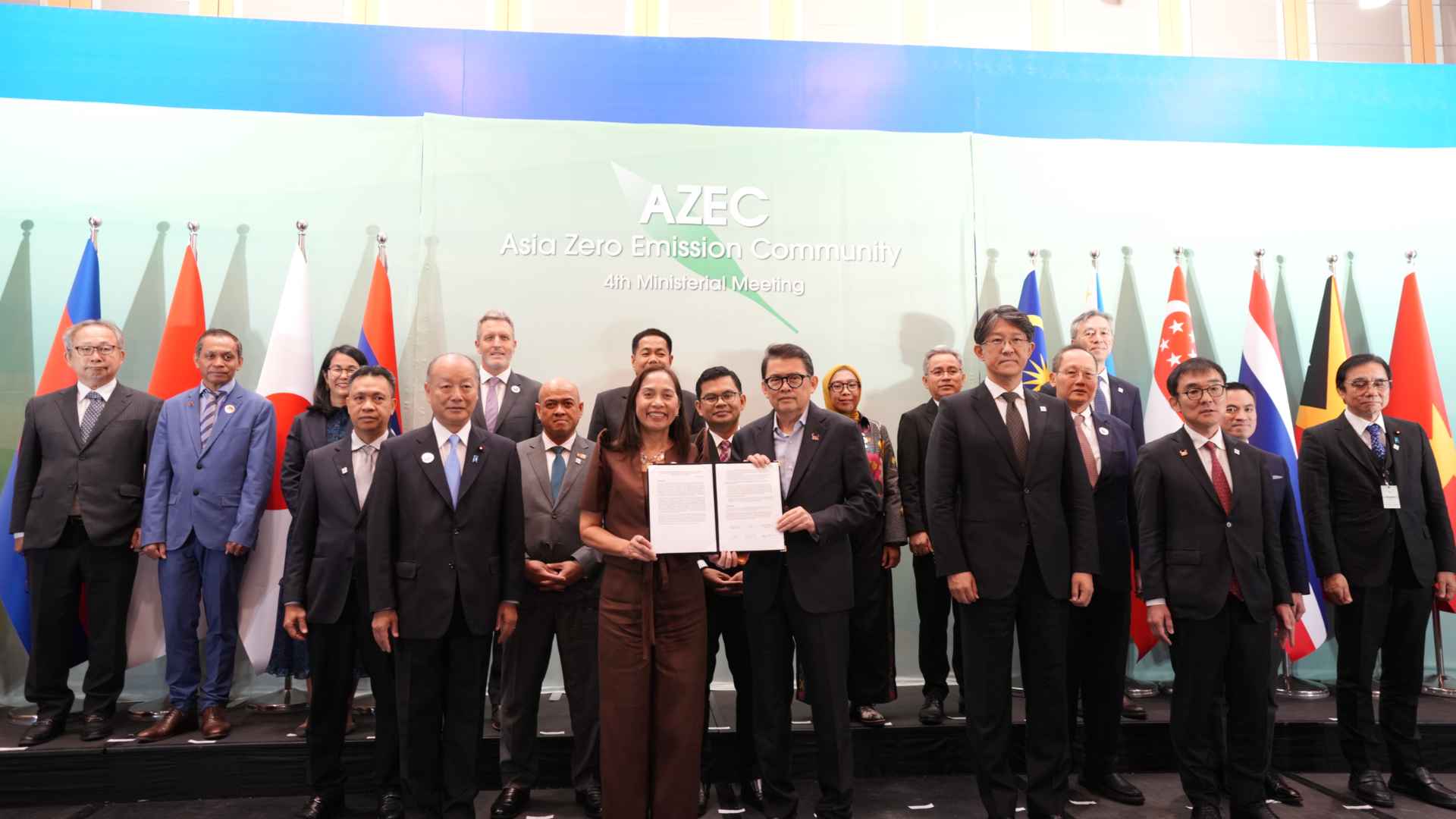
MANILA, 10 OCTOBER 2026 — The ASEAN Business Advisory Council (ASEAN-BAC), Keidanren (Japan Business Federation) and the Economic Research Institute for ASEAN and East Asia (ERIA) called for stronger regional cooperation on energy and critical mineral security following the presentation of their joint recommendation at the Asia Zero Emission Community (AZEC) Ministerial Meeting on October 8 at the Philippine International Convention Center (PICC).
The three organizations that form the AZEC Advocacy Group are led by ASEAN-BAC Chair Jose Ma. “Joey” Concepcion III, ERIA President Tetsuya Watanabe, and Keidanren Vice Chair Koji Sato. The group urged partner governments to strengthen and evolve AZEC from a climate initiative into a broader platform for resilient energy and resource supply chains and, at the same time, advance decarbonization and economic growth.
The statement comes in the wake of the Strait of Hormuz crisis, which underscored Asia’s exposure to energy supply disruptions. Nearly 90% of the crude oil transiting the Strait is destined for Asia. Growing global competition for critical minerals, meanwhile, is creating new vulnerabilities for regional supply chains serving batteries, motors and semiconductors.
“The Hormuz crisis reminded us in ASEAN how quickly an energy shock becomes a cost shock, a logistics shock and a jobs shock,” said ASEAN-BAC Chair Jose Ma. “Joey” Concepcion III. “Energy security, decarbonization and economic growth have to be delivered together. AZEC can help make that transition more secure, more investable, and more beneficial to businesses and communities across Asia. ASEAN’s private sector is ready to put capital and projects behind it.”
Concepcion said the crisis also presents an opportunity for ASEAN to deepen regional integration and create new areas for private-sector investment.
“For ASEAN, the opportunity is as large as the risk,” Concepcion added. “A more connected ASEAN Power Grid, stronger regional supply chains for critical minerals and clearer rules for transition finance can strengthen our economies while creating new opportunities for business, including and especially MSMEs.”
The AZEC Advocacy Group supports government-level efforts to respond, including the Partnership on Wide Energy and Resources Resilience Asia (POWERR Asia) launched by Japan at the AZEC+ Online Meeting on 15 April 2026.
Three priorities for a stronger AZEC
1. Energy resilience. Governments should diversify energy sources along pathways suited to each country’s circumstances, while balancing safety, energy security, economic efficiency and environmental sustainability. With energy demand still rising across the region, the business community holds that an overnight break from fossil fuels is neither realistic nor practical. AZEC partners should:
- Set clear transition roadmaps to reduce fossil-fuel dependence, while maintaining stable oil and gas supplies during the transition and giving investors greater certainty.
- Use LNG as a transition fuel and reduce emissions from existing coal plants through higher efficiency, ammonia co-firing and CCUS.
- Accelerate carbon-neutral fuels such as hydrogen, ammonia, e-fuels, e-methane, biofuels and sustainable aviation fuel, supported by common standards and appropriate financing.
- Expand renewables and nuclear power to meet rising electricity demand, including demand driven by AI and digitalization.
- Invest in energy storage and stronger grids, including the ASEAN Power Grid, to expand cross-border trade in renewable electricity.
- Strengthen government-led strategic oil stockpiling systems, drawing on Japan’s nearly 50 years of experience.
- Improve energy efficiency through better technologies, energy management and greater alignment of efficiency standards across AZEC.
2. Resource security. Mining, smelting and refining of critical minerals are essential to the clean-energy and digital economies, but their production, processing and refining remain concentrated in a limited number of countries. AZEC partners should reduce excessive dependence on individual sources and build stronger regional supply chains. They should:
- Diversify mineral supplies through joint exploration, processing and refining, while developing substitutes for scarce resources.
- Deepen strategic partnerships through joint investment, technology cooperation and capacity building.
- Build regional resource-recovery networks to collect and recycle e-waste, end-of-life vehicles and EV batteries, recovering critical minerals and other valuable materials.
- Leverage Japan’s experience and capabilities in recycling, technology and institution building to support resource-circulation industries across AZEC.
3. Enabling environment. Unlocking the investment needed for the transition will require greater predictability, lower risks and closer public-private cooperation. Political, currency, credit and regulatory risks continue to make many low-carbon and circular-economy projects difficult to finance. AZEC partners should:
- Expand blended finance and risk-mitigation tools, including financing frameworks for hard-to-abate sectors.
- Strengthen cooperation among development banks, export credit agencies and private financial institutions to mobilize more capital.
- Align greenhouse gas accounting, MRV and disclosure standards to give investors and businesses clearer and more reliable information.
- Streamline cross-border carbon-market mechanisms, including common and transparent procedures for Joint Crediting Mechanism (JCM) projects consistent with Article 6 of the Paris Agreement.
- Build specialized talent through capacity-building programs and personnel exchanges among business, government and academia.
# # #
ABOUT ASEAN-BAC
The ASEAN Business Advisory Council (ASEAN-BAC) was established by ASEAN Leaders in 2003 as the apex private-sector body of ASEAN. It provides private-sector feedback and guidance to support ASEAN’s economic integration, and its members are business leaders appointed by each ASEAN Member State. ASEAN-BAC’s 2026 theme under the Philippines’ chairmanship is “Navigating Our Future Together: Advancing Prosperity for All”.
ABOUT THE AZEC ADVOCACY GROUP
The AZEC Advocacy Group brings together ASEAN-BAC, Keidanren, ERIA and other experts in Asia to support public–private cooperation on decarbonization under the Asia Zero Emission Community. It was established through a joint statement issued on 16 December 2023 at the ASEAN-Japan Economic Co-Creation Forum. AZEC’s partner countries are Australia, Brunei Darussalam, Cambodia, Indonesia, Japan, Lao PDR, Malaysia, the Philippines, Singapore, Thailand and Viet Nam.
MEDIA CONTACT
Mr. Rifki Weno, Executive Director, ASEAN-BAC Secretariat · rifki@asean-bac.org
Mr. Patrick Chua, Executive Director, ASEAN-BAC Philippines · patrick.chua@aseanbac.ph